

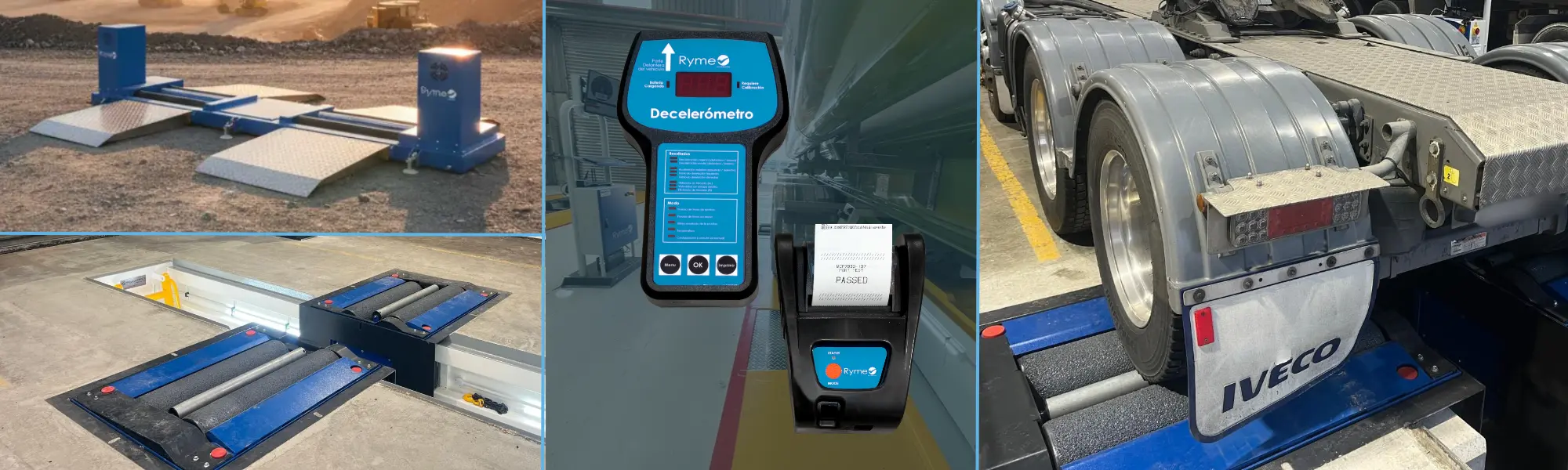
Roller brake testers and decelerometers both have a place in heavy vehicle brake testing in Australia, but they perform very different types of tests. Understanding that difference is important when considering what each test can tell you about a vehicle’s braking performance.
A decelerometer measures how quickly a vehicle slows during a dynamic braking test. A roller brake tester (RBT) measures the braking force generated while the vehicle remains stationary on powered rollers.
Both can be used to assess braking performance, but the testing method and the information they provide are different.
What Is a Roller Brake Tester?
A roller brake tester is a diagnostic system that measures braking force. During testing, the vehicle is positioned on powered rollers that rotate the wheels at a controlled speed. As the brakes are applied, the system records the resulting forces.
Depending on the equipment and configuration, measurements can include:
- Brake force
- Left-to-right brake imbalance
- Braking efficiency
- Rolling resistance
- Ovality
- Vehicle or axle weight
For example, the Ryme Worldwide FRU 4 truck roller brake tester has a maximum axle load of up to 20 tonnes and measures braking force, rolling resistance and braking performance, with ovality and weight measurement available.
By measuring braking force, an RBT provides detailed diagnostic information that can help workshops assess braking performance and identify areas requiring further investigation.
What Is a Decelerometer?
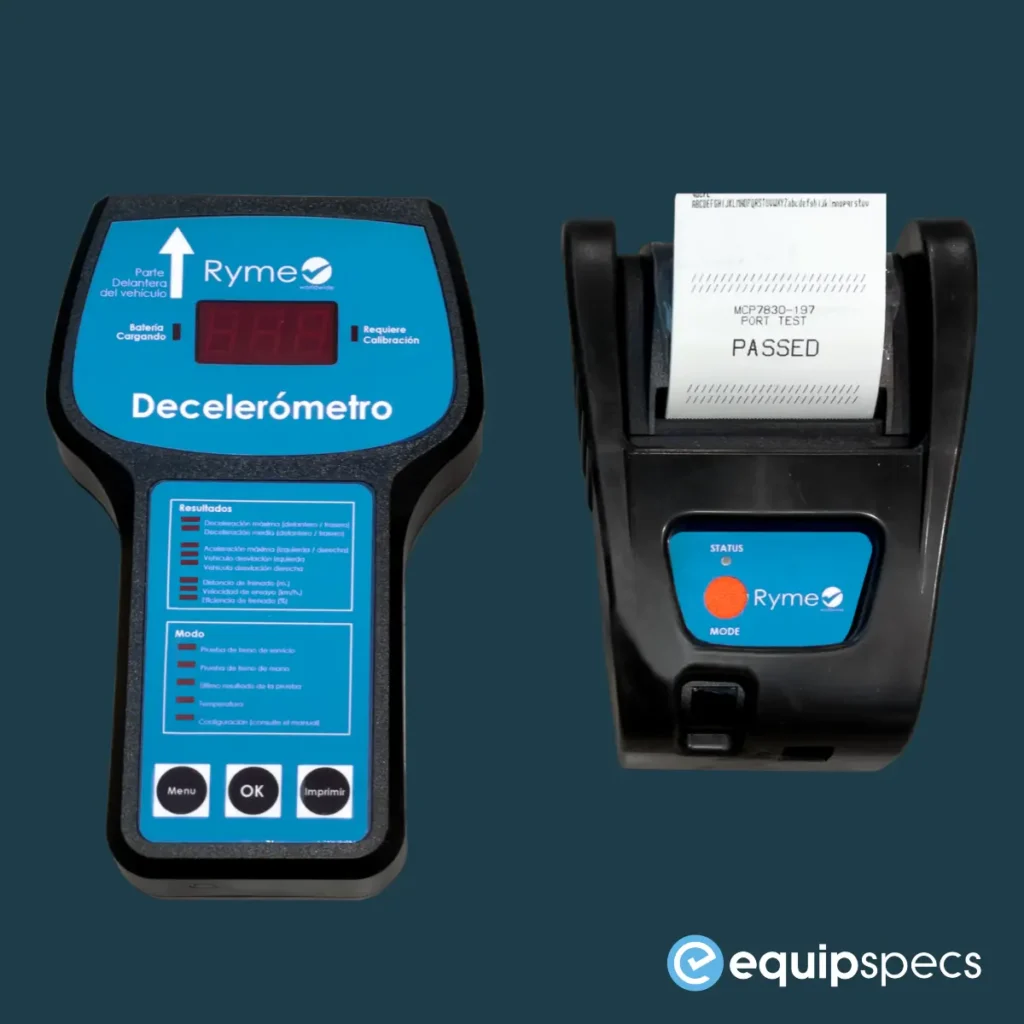
A decelerometer is an in-vehicle brake testing device that measures the rate of deceleration achieved during a controlled braking test. During testing, the device is positioned inside the vehicle, which is driven to the required test speed before the brakes are applied under the prescribed test conditions. The decelerometer records the vehicle’s deceleration during the braking event.
The Ryme Worldwide BrakeCheck decelerometer measures service-brake and hand-brake performance through deceleration. It also measures front/rear deceleration and left/right acceleration, and can calculate stopping distance and test speed. The device provides an indication when the vehicle pulls to the left or right during the test.
This provides a portable method of measuring the overall braking performance of the vehicle during a dynamic brake test.
Roller Brake Tester vs Decelerometer: What Is the Main Difference?
The key difference is how braking performance is measured: a roller brake tester measures the braking force generated at the individual wheels, while a decelerometer measures the vehicle’s rate of deceleration during a dynamic braking test.
| Roller Brake Tester | Decelerometer |
| Vehicle remains stationary during the test | Vehicle is driven during the test |
| Wheels are rotated by powered rollers | Vehicle undergoes a controlled braking event |
| Measures brake force at each wheel position | Measures vehicle deceleration |
| Can compare braking performance across an axle | Assesses overall vehicle braking performance |
| Can identify left/right brake-force imbalance | Can indicate whether the vehicle pulls during braking |
| Can measure additional factors such as rolling resistance and ovality | Can measure/calculate values such as deceleration, stopping distance and test speed |
| Available as fixed/in-ground or mobile equipment | Small, portable in-vehicle device |
Each method measures different aspects of braking performance, which is reflected in the information provided at the conclusion of testing.
What Can a Roller Brake Tester Tell a Workshop?
One of the significant differences between the two methods is the level of information available to the technician.
If a vehicle produces an unsatisfactory braking result during a dynamic test, further investigation may be required to establish what is happening within the braking system.
A roller brake tester can provide wheel-level brake-force measurements and compare the braking performance on the left and right sides of an axle.
This can help technicians identify areas requiring further inspection, including:
Brake imbalance: A difference between braking forces on the left and right sides of an axle.
Insufficient brake force: A wheel or axle that is not producing the expected braking performance.
Rolling resistance: Resistance measured before the brakes are applied.
Ovality: Variations in braking force as the wheel rotates, which can help identify inconsistent braking performance.
Following adjustments or repairs, the vehicle can then be tested again to measure the result.

How Does a Decelerometer Test Differ?
A decelerometer assesses braking performance while the vehicle is moving.
NHVR heavy vehicle inspection guidance describes a decelerometer test as involving a suitable device positioned in the vehicle cab, with the vehicle driven to the required test speed before the brakes are applied in a sustained, smooth application.
The test therefore assesses the vehicle’s braking performance under a dynamic stopping event, which is an important distinction when comparing brake testing equipment.
A decelerometer can establish how effectively the vehicle decelerates under the prescribed test conditions. A roller brake tester measures braking force under controlled test conditions, providing detailed information about braking performance.
Are Both Methods Used for Heavy Vehicle Brake Testing in Australia?

Yes. Australian heavy vehicle inspection guidance recognises different methods of brake testing. However, test procedures and equipment requirements are not identical, and specific inspection requirements can vary between jurisdictions and inspection schemes.
For this reason, operators should refer to the requirements that apply to their particular testing or inspection operation when selecting brake testing equipment.
A Current Example: Portable Decelerometers in NSW
New South Wales provides a useful example of how these jurisdictional requirements can differ.
Under the NSW Authorised Inspection Scheme, requirements for portable brake-testing decelerometers were updated to require the device to print the speed of the test, with a transition period applying until 1 July 2026.
NSW guidance also specifies additional requirements for mobile examiners, including the use of GPS-enabled brake-testing decelerometers.
Does a Portable Brake Tester Mean a Decelerometer?
Not necessarily.
This is an important distinction because the terms portable brake tester and mobile brake tester can describe very different types of equipment.
A decelerometer is portable because the small device can be carried into the vehicle for a dynamic braking test.
However, a roller brake tester does not necessarily require a permanent in-ground installation either.
Mobile Roller Brake Testing
The Ryme Worldwide FRU 9 is a mobile heavy vehicle roller brake tester.
Instead of being permanently installed into a workshop floor, the FRU 9 is designed for deployment without prior civil works. It can be transported by a light vehicle and assembled without special tools.
Despite being mobile, it remains a roller brake tester rather than a decelerometer.
The FRU 9 has a maximum axle load of up to 18 tonnes and measures:
- Brake force and performance
- Rolling resistance
- Ovality
This gives workshops and fleet operators another option between a small in-vehicle decelerometer and a permanently installed heavy vehicle roller brake tester.

Which Brake Testing Method Do You Need?
The answer depends on what needs to be measured and the requirements applying to your testing operation.
A decelerometer provides a portable method of assessing the overall braking performance of a moving vehicle.
A roller brake tester measures braking force under controlled test conditions, providing detailed information about braking performance. Roller brake testing also forms part of heavy vehicle compliance testing requirements in Australia, subject to the applicable jurisdiction and inspection scheme.
Heavy Vehicle Brake Testing Solutions from EquipSpecs
EquipSpecs supplies Ryme Worldwide heavy vehicle roller brake testers and brake testing equipment across Australia, with solutions for permanent workshop installations and mobile testing applications.
From the FRU 4 heavy vehicle roller brake tester to the mobile FRU 9, we can help you select a brake testing system suited to your vehicles, workshop and testing requirements.
Contact EquipSpecs to discuss the right heavy vehicle brake testing solution for your operation.
Frequently Asked Questions
A roller brake tester measures braking force at the vehicle’s wheels while they are rotated on powered rollers. A decelerometer is used during a dynamic braking test and measures how quickly the vehicle slows.
A decelerometer measures the deceleration of the vehicle during a braking event. It does not directly measure the braking force generated at each individual wheel in the way a roller brake tester does.
Yes. By measuring braking force on the left and right sides of an axle, a roller brake tester can identify differences in braking performance between the wheels.
Not always. Decelerometers are portable brake-testing devices, but mobile roller brake testers are also available. The Ryme Worldwide FRU 9, for example, is a mobile heavy vehicle roller brake tester rather than a decelerometer.
Yes. The Ryme Worldwide FRU 9 is designed for heavy vehicles with axle loads up to 18 tonnes and provides roller brake testing without requiring permanent in-ground installation.
Australian heavy vehicle inspection guidance recognises decelerometer, skid plate and roller brake testing methods. Operators should check the requirements that apply to their jurisdiction and inspection scheme, as procedures and equipment requirements can differ