

How lifting bed technology delivers safer, more reliable results for heavy-vehicle workshops
Accurate brake testing is one of the most important safety checks performed in any heavy-vehicle workshop. Whether you’re maintaining a fleet, preparing vehicles for compliance inspections, or servicing customer trucks, the reliability of the brake test determines the reliability of the outcome.
Across Australia, more workshops are looking closely at accuracy, repeatability, and real-world relevance when choosing brake testing equipment. And one factor consistently stands out:
Load simulation.
Heavy vehicles don’t brake the same when empty. If a truck, bus, or trailer is tested without a representative load, the readings may not reflect true on-road stopping performance — especially for modern vehicles with intelligent braking systems.
This is where lifting bed load simulation, as found in the Ryme Worldwide FRU 4 Truck Roller Brake Tester supplied by EquipSpecs, makes a measurable difference.
Why Load Matters in Heavy Vehicle Brake Testing

Most heavy vehicles achieve their true braking performance only when carrying weight. When empty or lightly loaded, the following issues are common:
- Premature wheel lock due to low axle load
- Lower-than-normal brake force readings
- Different ABS/EBS activation timing
- Variations between repeated tests
- Unrepresentative data that doesn’t match the vehicle’s daily operation
This can lead to:
- technicians chasing faults that aren’t actually there, or
- genuine issues being missed entirely.
For mixed fleets, Transport Operators, councils, and service environments, this uncertainty impacts both safety and maintenance planning.
Load simulation solves this by replicating real operating conditions — without having to physically load the vehicle.
How Lifting Bed Load Simulation Works
Load simulation applies controlled downward pressure onto the axle during the brake test, creating the same conditions the vehicle experiences under load.
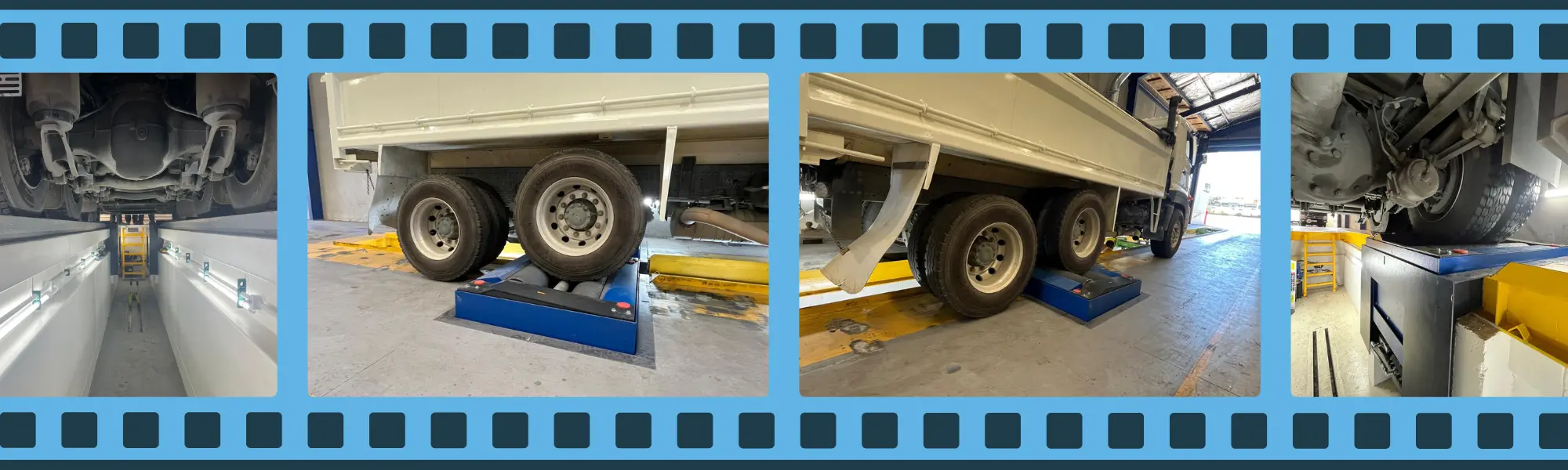
The Ryme Worldwide FRU 4 achieves this using an integrated lifting bed built directly beneath the rollers.
During the test:
- The vehicle positions over the rollers
- The lifting bed raises from below
- Additional force transfers onto the axle
- Tyre contact increases
- Brake readings stabilise and become real-world accurate
The result is a repeatable, reliable brake test.
For workshops, this delivers:
- fewer retests
- faster workflow
- more consistent reporting
- better insight into true brake performance

Why Load Simulation Is Becoming a Global Standard
Across Europe, the UK, and many parts of Asia, load simulation is now mandatory or strongly recommended for heavy-vehicle brake testing. This global shift is driven by:
- higher fleet safety expectations
- advanced brake systems requiring stable test conditions
- the need for reproducible digital records
- tighter operator liability frameworks
- the move toward predictive, data-led maintenance
Australia faces the same requirements: heavier fleets, longer distances, and more complex braking technology.
Workshops upgrading today are choosing equipment that aligns with these evolving international standards — and load simulation is central to that future-proofing.
The Ryme Worldwide FRU 4: Engineered for Accuracy
EquipSpecs supplies the Ryme Worldwide FRU 4 Truck Roller Brake Tester with integrated lifting bed load simulation across Australia — a system engineered for accuracy, durability, and long-term performance in high-demand environments.
Key Advantages
✔ Integrated rising bed load simulation
✔ Stable, repeatable brake results
✔ Designed for heavy-vehicle industries
✔ High-strength roller construction
✔ Clear digital reporting
For workshops looking to improve testing capability without slowing down operations, the FRU 4 represents a meaningful, future-proofed upgrade.
The Real Advantage: Better Data, Better Decisions
Accurate brake test results do more than support compliance — they directly influence:
- maintenance scheduling
- workshop efficiency
- fleet reliability
- downtime reduction
- safety outcomes
For high-throughput workshops and fleet depots, consistent, load-representative data improves confidence in every service, inspection, and maintenance decision.
Simply put:
better load simulation = better test results = better fleet safety.
Is It Time to Upgrade Your Brake Testing Equipment?

A brake tester with integrated load simulation is ideal for workshops that are:
- expanding in-house testing capability
- supporting larger or more diverse fleets
- preparing vehicles for regulatory inspections
- replacing older brake test equipment
- aligning with international testing standards
- wanting more reliable, repeatable results
EquipSpecs provides full support across Australia, including advice on layout, compatibility, installation planning, and long-term servicing.
Talk to EquipSpecs About Brake Testing Equipment in Australia
EquipSpecs supplies a full range of heavy-vehicle testing solutions across Australia, including:
- Ryme Worldwide FRU-4 Roller Brake Tester with lifting-bed load simulation
- FRL 5.5 light-vehicle brake tester
- Headlight testers
- Play detectors
- Workshop safety and equipment packages
- Turnkey equipment solutions for new and existing workshops
Whether upgrading an existing facility or developing a new inspection area, our team can help you choose the right equipment for accuracy, efficiency, and long-term performance.
2 Responses
[…] You can read more about why this matters in Australia here:Load Simulation Brake Testing Australia […]
[…] Workshops interested in this topic can learn more in our article on load simulation brake testing in Australia. […]